Recognition of the impact of AI has created a focus on Talent Acquisition to become more strategic. I notice in judging the ITA’s this month that there are organisations who are using Market intelligence, talent mapping, workforce analytics and AI are enabling the TA Functions to make better hiring decisions than ever before.
But after helping many organisation’s try and transform their TA teams to be Talent Advisors , I’ve noticed an interesting pattern. Most Talent Advisory doesn’t fail. It simply reaches a natural point where the conversation becomes better hiring rather than better workforce decisions.
Recruitment is still the default solution. BUT it’s just a better-informed recruitment decision. I don’t believe that’s the destination. I believe it’s one stage in a much larger journey.
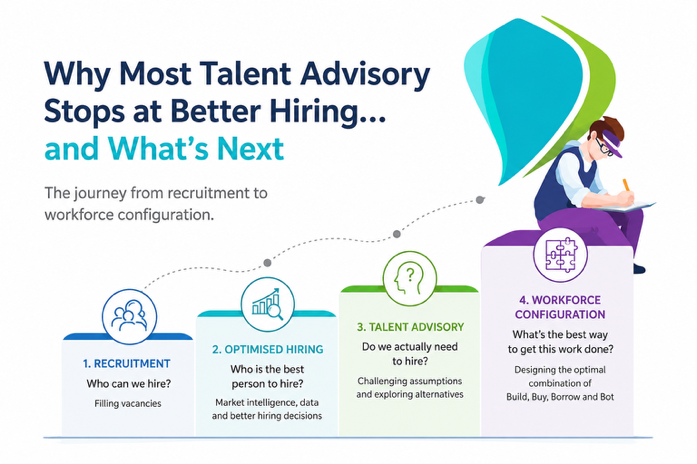
The Four Stages of Talent Advisory
As I reflect on the organisations we’ve assessed and worked with, a simple maturity model is beginning to emerge.
| Stage | Primary Question | Focus |
| 1. Recruitment | Who can we hire? | Filling vacancies |
| 2. Optimised Hiring | Who is the best person to hire? | Market intelligence, data and better hiring decisions |
| 3. Talent Advisory | Do we actually need to hire? | Challenging assumptions and exploring alternatives |
| 4. Workforce Configuration | What’s the best way to get this work done? | Designing the optimal combination of Build, Buy, Borrow and Bot |
The interesting observation is that many organisation’s are operating in stage 1 and some organisations are starting to operate in Stage 2. That’s not a criticism. In fact, while I am disappointed at the speed having run events at the ATC for 20 years its where I’d expect the market to be.
The use of labour market intelligence, competitor insights, salary benchmarking and AI is helping Talent Acquisition functions make significantly better hiring decisions. The challenge is that the conversation is still centred on the role.
The Real Shift Happens at Stage Three
The transition from Stage 2 to Stage 3 is where Talent Advisory really begins.
Instead of asking:
“Who’s the best person to hire?”
the conversation becomes:
“Do we actually need to hire?”
That’s a very different discussion.
Perhaps the capability already exists internally.
Perhaps adjacent skills could be developed.
Perhaps contingent capability is more appropriate.
Perhaps part of the work could be automated.
For the first time, recruitment becomes one option rather than the default answer.
Stage Four Changes the Conversation Completely
The final shift is even bigger. Instead of discussing jobs, organisations begin discussing work.
The question changes again: “What’s the best way to get this work done?”
The answer may involve several people, AI, automation, contractors, internal mobility or permanent recruitment. Or more likely, a combination of them.
This is what I increasingly describe as Workforce Configuration. It’s no longer about filling positions. It’s about configuring capability to deliver business outcomes.
Can Organisations Leapfrog to Stage Four?
It’s a question I’ve been thinking about a lot. My instinct is that most organisations probably can’t. Each stage builds the capability required for the next. Better hiring develops commercial thinking and credibility, team and capability. Talent Advisory develops the confidence to challenge assumptions.
Only then are organisations ready to redesign work itself. Rather than viewing this as a limitation, I think it provides a practical roadmap for Talent Acquisition leaders looking to evolve their function.
Where Are You Today?
One of the reasons we developed the Talent Advisory Continuum Assessment was to help leaders understand where their teams sit on this journey.
The assessment benchmarks current capability, highlights strengths and development opportunities, and provides an objective view of what will help a Talent Acquisition function progress from recruitment excellence towards true Talent Advisory.
If you’re interested in understanding where your team sits on the journey, you can explore the assessment here:
Talent Advisory Continuum Assessment
I’d also be interested in your perspective.
Do you believe organisations can leapfrog directly to Workforce Configuration, or is progressing through these stages a necessary part of the journey?
Recent Comments